


A cluttered garage has a way of turning simple tasks into small adventures. Finding a screwdriver means moving three boxes. Grabbing a rake requires shifting a bicycle. Somewhere behind a mountain of storage bins sits the thing you came to find. What should be a practical extension of your home becomes a room full of obstacles.
The solution often begins by looking up. Garage walls offer valuable storage space, but choosing how to use them raises an important question: Should you hide everything behind cabinet doors or keep your belongings visible on open shelves?
The debate over garage cabinets vs wall shelving comes down to your budget, available space, storage habits, and need for protection. Understanding these differences helps you create a garage that looks organized, functions efficiently, and stays that way long after the initial cleanup.
Understanding Garage Wall Shelving
Garage wall shelves turn unused wall space into practical storage. Mounted securely to wall studs or suitable masonry, these systems hold everything from heavy storage bins to gardening equipment. They come in several materials, including metal, wood, and wire, allowing homeowners to choose according to their needs and budget.
Their main advantage is accessibility. Visible items are easy to locate and retrieve, making open shelving ideal for frequently used tools, sports equipment, seasonal decorations, and bulky containers. Mounting shelves above the floor also preserves room for vehicles, workbenches, and everyday activities.
However, exposed belongings collect dust, cobwebs, and moisture, especially in garages without climate control. Shelves can also look untidy when containers vary in size or items lack designated places. Matching bins and clear labels help maintain a cleaner appearance without sacrificing convenience.
Weight capacity is another important consideration. A shelf's advertised limit does not guarantee that every wall can support the same load. Appropriate anchors, suitable mounting surfaces, correct installation, and balanced weight distribution are essential. Always follow the manufacturer's instructions and never exceed the stated limits.
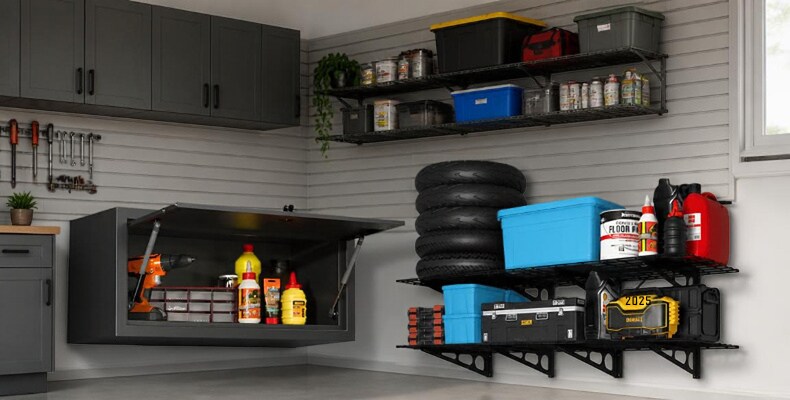
For homeowners who need substantial storage capacity, the Fleximounts WR26 Classic 2-Pack 2' x 6' Wall Shelving offers a practical option. Each unit supports up to 350 pounds, giving the two shelves a combined capacity of 700 pounds. The system accommodates specified wood stud spacing of 16, 18, or 24 inches, and suitable concrete or brick installations. It cannot be mounted on metal stud walls.
The package includes mounting hardware, an installation template, and a bubble level to simplify setup. Its buckle design and hook-and-loop fasteners help secure the brackets. With room for tires, tools, and heavy storage bins, these shelves make effective use of vertical space while keeping frequently needed belongings accessible.
Why Garage Cabinets Deserve a Closer Look
Garage cabinets offer a different approach to organization by concealing belongings behind doors. Available in steel, resin, and engineered wood, they range from compact wall-mounted units to larger modular systems.
Their appeal goes beyond appearance. Closed doors create a streamlined look by hiding loose tools, cleaning supplies, and miscellaneous equipment. They also provide a barrier against dust, saw debris, and accidental splashes, making them useful for items that benefit from additional protection.
Lockable cabinets can help restrict access to sharp tools and potentially hazardous products, particularly in households with children or pets. However, paints, pesticides, and other chemicals must still be stored according to their labels. Standard cabinets are not necessarily airtight, waterproof, or suitable for every hazardous substance.
The main considerations are cost and clearance. Heavy-duty cabinets generally require a larger initial investment than basic shelving, especially when custom installation is involved. Their doors also need sufficient room to open, although wall-mounted models and upward-lifting designs can help preserve usable floor space.
The Fleximounts WSC1 Wall Mounted Metal Hanging Storage Cabinet offers enclosed storage in a compact design. Constructed from 0.65-millimeter SPCC steel with a powder-coated finish, it is designed to resist rust and support up to 120 pounds per shelf. Its locking mechanism includes two keys, while the upward-lifting door reduces interference with nearby space and the risk of bumping into a projecting door.
The cabinet arrives flat-packed with identified parts, clear instructions, and an installation video. For homeowners who want a durable place for tools and supplies, it combines a clean appearance with practical security.
Garage Cabinets vs Wall Shelving: What Matters Most?
The best choice depends on how your garage functions. Consider four factors before making a purchase.
Space and accessibility. Open shelves provide direct access without requiring door clearance, which is useful beside parked vehicles or in narrow garages. Cabinets need room for their doors and handles, so measure carefully around car doors, walkways, and work areas.
Cost and long-term value. Basic shelving usually costs less upfront, while cabinets often command higher prices because of their construction and locking hardware. Compare weight ratings, materials, installation requirements, and expected durability rather than choosing by price alone.
Protection and maintenance. Shelves make belongings easy to inspect but leave them exposed to dust. Cabinets reduce direct exposure, although their interiors still require cleaning. In humid garages, neither option eliminates condensation or corrosion. Suitable materials, ventilation, and moisture control remain important.
Flexibility and appearance. Adjustable shelving accommodates changing container sizes, while fixed cabinet interiors may limit rearrangement. Modular cabinets and adjustable shelf systems offer greater adaptability. Visually, open shelving suits a practical workshop, while enclosed cabinets create a more streamlined finish.
Thinking through these factors helps you choose a system that supports your routine instead of creating new inconveniences.
Why the Best Garage Organization Often Uses Both
You do not have to choose one storage system for the entire garage. Combining cabinets and shelves often makes better use of the available space because different belongings have different requirements.
Place cabinets at a comfortable working height for smaller tools, maintenance supplies, and items that need restricted access. Use shelves above or alongside them for labeled storage bins, sports equipment, camping gear, and seasonal decorations. This arrangement keeps everyday essentials accessible while making room for bulky belongings.
Consider a homeowner who enjoys cycling. Repair tools and small parts can stay inside a cabinet, while helmets, pumps, and spare equipment remain visible on nearby shelves. A family with gardening supplies could secure chemical products appropriately and keep empty pots and watering cans within easy reach.
Organize everything according to weight, frequency of use, and safety. Place heavy objects on appropriately rated lower shelves and reserve higher positions for lightweight seasonal items. Keep exits, electrical panels, and essential equipment unobstructed. Secure every wall-mounted system correctly to prevent objects from falling.
A hybrid arrangement also allows room for change. As hobbies evolve or household needs grow, you can rearrange shelf contents without replacing the entire setup.
Three Questions to Ask Before Buying
First, what is your budget? Shelving can provide substantial capacity at a lower initial cost, while cabinets may be worth the additional expense if concealed storage and locking doors are priorities.
Second, how much space remains when your vehicle is parked? Measure the available wall width, height, and depth. Check clearance around car doors, walking paths, garage door tracks, pipes, and electrical outlets before choosing a system.
Third, what will you store? Dust-sensitive equipment and items requiring restricted access may benefit from enclosed cabinets. Large containers, bulky sports equipment, and frequently used supplies are often better suited to open shelving.
Before ordering, list the ten bulkiest items you need to store. Measure them, estimate their weight, and consider how often you use each one. This simple exercise gives you a clearer picture of the capacity, accessibility, and protection your garage requires.
Make Every Inch of Your Garage Count
Choosing between garage cabinets and wall shelving is ultimately about matching your storage system to your lifestyle. Cabinets provide concealed organization and added security, while shelves offer convenient access and an economical way to reclaim floor space.
Start by measuring your garage and identifying which belongings need protection, which you use regularly, and which can be stored overhead. If your budget and layout allow, combine both systems to create a setup that balances function and appearance.
A well-organized garage does more than look good. It saves time, reduces frustration, and gives every tool a place. Measure your space, plan around your largest belongings, and build a storage system that makes daily life easier. Share your garage storage questions in the comments and start turning unused wall space into something genuinely useful.


