


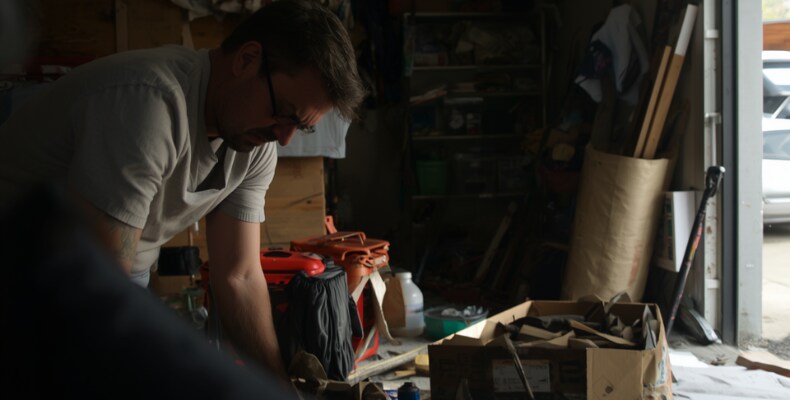
A garage has a peculiar way of keeping time.
Behind its doors, yesterday’s projects sit beside tomorrow’s plans. A child’s old bicycle leans against a stack of paint cans. Christmas decorations wait in battered cardboard boxes. There are tools bought for a project that never quite happened, spare parts for appliances that no longer exist, and objects kept because throwing them away somehow feels like admitting something.
Then one Saturday morning, you decide to clean.
What begins as a practical task quickly becomes something more complicated. You pick up an old tennis racket and remember who you used to play with. You find a box of school photographs and stop to look through it. You discover a half-finished project and remember how certain you once were that you would complete it.
The garage suddenly feels less like a storage room and more like an archive of your life.
That is why cleaning the garage can be so emotionally exhausting. The physical work is only part of it. You are also sorting memories, expectations, habits, and versions of yourself that no longer quite fit. The challenge is not simply deciding where something belongs. Sometimes, it is deciding whether it belongs in your life at all.
The Garage Quietly Becomes a Record of Your Life
Most garages do not become cluttered overnight. They evolve.
One box is placed in the corner because there is nowhere else to put it. A broken appliance waits for a future repair. A piece of furniture is saved because it might be useful in another room. Seasonal decorations are pushed farther back after every holiday. A few years pass, and the garage becomes a physical record of decisions made quickly and forgotten almost immediately.
Unlike the rest of the home, the garage often receives little daily attention. The living room gets tidied before guests arrive. The kitchen gets cleaned because it is used constantly. The garage can wait.
And so it waits.
Eventually, the accumulated objects begin to tell stories. Some are pleasant. Others are reminders of money spent, hobbies abandoned, projects postponed, or ambitions that quietly changed direction. Even an ordinary box can carry an unexpected emotional charge when it contains a piece of an earlier life.
This is why a serious garage cleanout can feel strangely personal.
The answer is not to become ruthless with your belongings. It is to become more deliberate. Ask what an object contributes to your life now. Some things deserve to stay because they are useful. Others deserve to stay because they carry genuine meaning. But an object does not need to remain simply because it once mattered.
Your past can remain part of your story without occupying every corner of your garage.
The Real Exhaustion Comes From Making So Many Decisions
Physical clutter is visible. Decision fatigue is not.
A crowded garage asks questions constantly. Keep the extra chairs? Save the old computer? What about those tiles left over from the renovation? Is that power tool still working? Could the children use those bicycles again? Should the camping equipment stay accessible or be stored away?
None of these questions is particularly difficult. The problem is volume.
When dozens or hundreds of objects demand individual decisions, even simple choices begin to feel heavy. You can spend an entire afternoon surrounded by boxes and still feel as though you have accomplished very little.
A more thoughtful approach is to establish a framework before you begin. Think about usefulness, frequency, condition, replacement cost, and sentimental value. These questions create distance between the object and the emotion surrounding it.
It also helps to work by category rather than by corner. Gather the tools together. Bring out the sports equipment. Put seasonal decorations in one place. Once similar belongings are visible together, the truth becomes easier to see. You may discover that you own five versions of something you thought you had only once.
That moment is useful.
Good garage organization is not about making everything disappear. It is about making decisions once, clearly, so you do not have to make them again every time you open the garage door.
A Cluttered Garage Changes the Way You Use Your Home
A garage can be full without being useful.
This distinction matters. Storage is supposed to make life easier, yet poorly organized storage can do the opposite. When boxes cover the floor, tools disappear behind equipment, and bulky items lean against every available wall, even ordinary tasks become inconvenient.
You know the screwdriver is somewhere in there. You just do not know where.
That small uncertainty has a surprising effect. You postpone repairs. You avoid hobbies. You leave things outside because putting them away takes too much effort. Eventually, the garage becomes a space you navigate around rather than a space you use.
This is where vertical storage becomes especially valuable.
Fleximounts wall shelving can help turn unused wall space into practical storage while keeping frequently used belongings within reach. Instead of allowing boxes, equipment, and tools to compete for precious floor space, shelving can give each category a defined place.
The ceiling can offer another opportunity. Fleximounts overhead garage storage racks can make use of otherwise neglected overhead space for items that are needed less frequently, such as seasonal decorations, luggage, or bulky household supplies.
The goal is not to squeeze every possible object into the garage.
It is to create breathing room.
A well-organized garage should allow you to see what you own, reach what you need, and return things without creating another mess. The best storage system is therefore not necessarily the one that holds the most. It is the one that reduces the effort required to use the space.
“What If I Need It?” Is Often the Hardest Question
Perhaps the most persistent reason people keep garage clutter is uncertainty.
You look at an old item and think, “What if I need this someday?”
It is a reasonable question. Life is unpredictable, and throwing something away can feel like making an irreversible decision. Keeping it feels safer. The object remains available, just in case.
But “just in case” has a cost.
Every object occupies physical space. It also competes with the things you actually use. A box of forgotten supplies may sit untouched for years while your everyday equipment gets pushed into an inconvenient corner.
The answer is not to discard everything that has not been used recently. Some things are genuinely worth storing. A specialized tool, important document, seasonal item, or expensive piece of equipment may have little daily value but significant practical value.
The more useful question is this: How likely is that future need, and how difficult would the item be to replace?
That question introduces perspective.
If something is expensive, difficult to find, or important for a predictable seasonal need, keeping it may be sensible. If it is inexpensive, easily replaced, and has remained untouched for years, the argument for keeping it becomes weaker.
There is also another possibility worth considering. Sometimes we keep objects because they represent a person we intended to become.
The unused woodworking tools may belong to the version of you who planned to build furniture. The camping equipment may belong to the version of you who imagined spending every weekend outdoors. The exercise equipment may belong to an earlier promise made to yourself.
Those versions of you mattered.
They simply do not have to occupy the entire garage.
The Point of a Clean Garage Is Not Perfection
After hours of sorting, lifting, wiping, carrying, and deciding, it is tempting to measure success by appearance alone.
But a beautiful garage is not necessarily an organized garage.
The better measure is function.
Can you find the drill without opening every container? Can you reach the holiday decorations without moving six other boxes? Can you store a bicycle without blocking the walkway? Can you put something away quickly after using it?
These questions reveal whether the organization actually works.
A useful garage has zones. Frequently used items should remain easy to reach. Seasonal belongings can occupy less accessible areas. Heavy objects should be stored securely and appropriately. Similar items should live together. Shelving and overhead storage should support the way the household actually uses the space rather than forcing everyone to follow an overly complicated system.
That is where products such as Fleximounts wall shelving and Fleximounts overhead garage storage racks can become part of a larger organization strategy. The purpose is not simply to add storage. It is to make the available space work harder while leaving the floor clearer and everyday belongings easier to access.
In the end, the emotional relief of cleaning the garage comes from something deeper than having a tidy room.
It comes from reducing friction.
You no longer have to search for what you need. You no longer have to step around things that have nowhere to go. You no longer have to repeatedly decide what to do with the same box every time you enter the room.
The garage becomes quieter.
And there is something satisfying about that quiet. Not because every object has disappeared, but because the things that remain have a purpose.
Perhaps that is why cleaning the garage can feel so exhausting and so rewarding at the same time. You are not merely organizing objects. You are drawing a line between what was useful once and what is useful now.
The boxes, tools, decorations, equipment, and forgotten possessions may have been collected over years. Sorting them takes patience because they are pieces of a much larger story.
But a home should make room for the life you are living, not only the lives you once imagined.
A well-organized garage gives that idea a physical form. The floor opens up. The walls become useful. The ceiling earns its keep. The things you actually need become easier to reach.
And suddenly, the garage is no longer a place where the past goes to wait.
It becomes part of the present again.


