


I used to believe clutter was a personality flaw. I told myself that messy garages belonged to busy people with full lives, people who simply did not have time to line things up neatly or label bins. I treated the chaos like proof that I was productive, not careless. Then one afternoon, I spent twenty full minutes looking for a screwdriver that was technically in my garage but spiritually lost forever. I checked boxes I had opened a dozen times before. I moved things that had not moved in years. I questioned my memory, my patience, and briefly my life choices. That was the moment it clicked. The problem was not me. It was the way I was using space, or more accurately, the way I was ignoring it.
My garage floor was doing all the work while my walls stood there, silent and empty, like coworkers who never volunteered but still took up space. Everything lived in piles, which meant nothing truly had a home. Once I invited the walls into the conversation, the chaos lost its grip. Tools rose to eye level. Boxes stopped stacking like a risky game. The space did not just look better. It started working better. And for the first time, I could find my screwdriver without a philosophical crisis.
When the Floor Becomes the Enemy
The first lesson I learned was that floors attract chaos. Once something lands there, it multiplies. A single box invites another box, then a bag, then something leaned casually against the wall that stays casual for three years. Floors feel convenient because they are close, but they are also lazy. They let clutter spread sideways, where it trips your feet and your patience. By shifting storage upward, I learned to think in layers instead of piles. Walls force decisions. You cannot just drop something on a shelf without thinking about balance, weight, and purpose. This alone reduces clutter because it adds a moment of pause. Educationally speaking, vertical storage changes behavior. Studies on space use show that visible and intentional placement reduces overbuying and duplicate items. When you see what you own, you stop buying what you already have. The floor stopped being a dumping ground and became a clear zone again, which oddly made the whole garage feel larger, calmer, and more respectful of my time.
Why Wall Shelves Do the Heavy Thinking for You
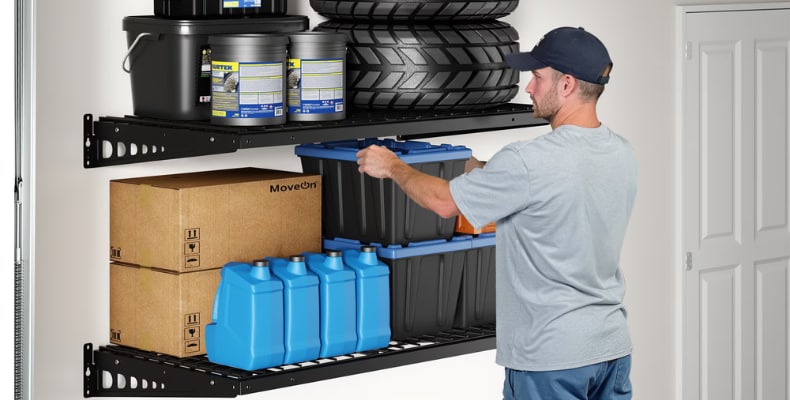
Wall shelves were my entry point into sanity. Not the flimsy kinds that bend under pressure, but solid shelves that demand respect. Installing shelves taught me an important principle of organization. Storage should work harder than you do. A well-built wall shelf carries weight, defines zones, and makes categories visible. I placed frequently used items at eye level and heavier bins lower for safety. This is not just practical but ergonomic. It reduces strain and speeds up daily tasks. One standout option was the Fleximounts BR24B Pro Series 2-Pack 2' x 4' Wall Shelving. With a combined load capacity of 660 pounds, it handled tools, bins, and gear without complaint. The one-piece grid design added stability, and the installation process was refreshingly straightforward. There is something deeply satisfying about shelves that stay level and do not wobble when you reach for a box. Add compatible hooks, and suddenly the same wall holds bikes, chairs, and tools like it planned ahead. Education meets relief when storage adapts to real life.
Cabinets and the Psychology of Hidden Mess
Not everything needs to be on display. This was a humbling realization. Open storage is honest, but it can also feel loud if overused. Cabinets brought visual quiet into the space. Wall-mounted cabinets hide the awkward stuff. Paint cans, cleaning chemicals, cords that refuse to behave. From an educational perspective, concealed storage reduces visual overload. Fewer visible items mean less mental fatigue. This is why clean spaces feel restful. Cabinets also protect items from dust and temperature swings, which matters more than we admit. Adjustable shelves inside cabinets allow flexibility as needs change, which is essential because storage that cannot evolve will fail. I learned to reserve cabinets for things I use occasionally but still need within reach. The result was a garage that felt intentional instead of apologetic. Everything still existed, but it stopped shouting for attention every time I walked in.
Pegboards, Hooks, and the Art of Easy Access
Pegboards and hooks taught me that organization does not need to be rigid to be effective. Pegboards are adaptable by nature. Hooks move. Tools rotate. Needs change. This flexibility makes pegboards educational tools in themselves. They encourage experimentation. You try one layout, live with it, then adjust. Over time, patterns emerge. You learn what you use often and what you can store higher or farther away. Hooks deserve special credit for handling bulky items that never fit in boxes. Bikes, ladders, extension cords, and folding chairs finally had a home that did not involve leaning and hoping. Hanging items vertically also improves safety. Fewer tripping hazards and fewer falling stacks mean fewer accidents. The humor in all this is that once everything had a hook or a peg, I stopped buying duplicates. Turns out I owned three tape measures. I just could not see them before.
How Using Walls Changed the Way I Think About Space
The biggest change was not physical. It was mental. Using walls effectively taught me to see space as a system, not a container. Every wall became an opportunity to solve a problem instead of hiding it. This mindset spilled into other areas of the house. Closets improved. Workflows improved. Even decision-making improved. Educationally, this is about spatial awareness and habit formation. When storage is visible, accessible, and logical, maintenance becomes easier than neglect. Humor sneaks in when you realize how dramatic clutter used to feel. What once felt overwhelming now feels manageable, almost polite. The walls quietly hold their share, and the floor gets to breathe. My garage did not become perfect. It became functional. And that is better. Order is not about looking impressive. It is about making daily life smoother, safer, and slightly more pleasant. All it took was letting my walls finally do some work.


