


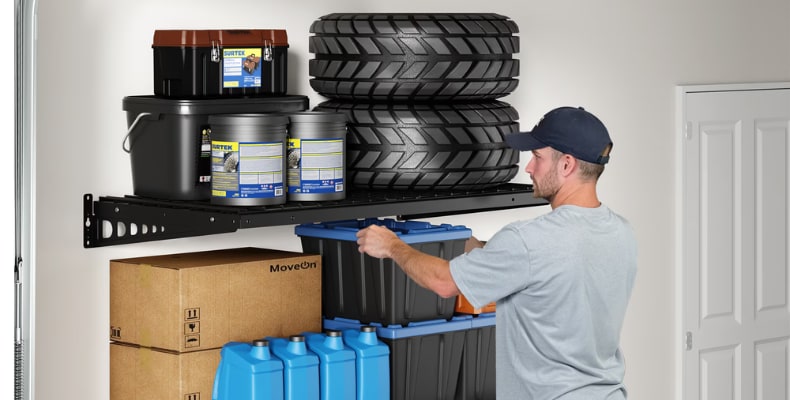
A garage can hold far more than it appears to. Look around and you will probably notice the obvious limitations first: the car takes up most of the floor, shelves are pushed against the walls, and every remaining corner seems to have claimed by boxes, tools, bikes, and equipment. But the real storage problem may not be a lack of space at all. It may be that too much of your available space is sitting at ground level.
Walls have been quietly waiting to do more work.
From the floor to the ceiling, a garage has layers of unused space that can become practical storage with the right setup. A sturdy wall shelf can lift storage bins several feet off the ground. Hooks can turn an empty wall into a home for bicycles, ladders, chairs, and tools. Cabinets and pegboards can give smaller items a clear place to live without spreading across your workbench or floor.
The idea is surprisingly simple: instead of making the garage bigger, make better use of the space it already has.
Vertical garage storage changes the way you see the entire room. What once looked like an ordinary wall becomes valuable storage real estate. What seemed like an overcrowded floor becomes open space again. And with a little planning, the same garage can hold considerably more while still feeling calm, accessible, and easy to use.
The trick is not to pack more into every available corner. It is to organize upward, create sensible zones, and give each item a proper place. Done well, wall-mounted storage can make even a modest garage feel considerably larger without changing its footprint by a single square foot.
Stop Storing Everything on the Floor
The floor is the easiest place to put something down, which is exactly why it becomes the most crowded part of the garage. Boxes get stacked in corners. Tools end up on workbenches. Bikes lean against walls. Garden equipment occupies valuable floor space. Before long, the garage becomes an obstacle course.
The simplest way to change that is to move storage upward.
Vertical garage storage makes use of wall space that would otherwise sit empty. A sturdy wall shelf can take several storage containers off the floor at once, while hooks can lift bicycles, folding chairs, ladders, hoses, and other bulky items into unused areas of the wall.
This approach does more than make the garage look cleaner. It changes how much usable floor space you have. A bicycle sitting on the ground consumes a surprising amount of room because you have to leave space around it. Hang that same bicycle securely on the wall, and the floor beneath it becomes available for something else.
The same principle applies to shelves. Instead of placing several plastic bins across the floor, stack them vertically on a properly mounted shelving system. You are not creating new square footage. You are simply taking advantage of the square footage that was already there.
The Fleximounts BR24 General 2-Pack 2′ X 4′ Wall Shelving is particularly useful for this approach. Its two shelves can be installed either parallel or vertically, giving you flexibility based on the shape and needs of your garage. The integrated grid construction provides a stable structure, while the system is designed to support substantial loads when properly installed.
The BR24 can also work with Fleximounts GRH2/GRH2B hooks, allowing the wall area to handle more than boxes and containers. Bikes, tools, chairs, and other items that can be hung vertically can be moved off the floor and onto the wall.
That combination matters because effective garage organization rarely comes from using one storage product for everything. Shelves handle containers and larger objects, while hooks deal with awkward items that do not stack neatly. Together, they help turn one empty wall into several layers of useful storage.
The key is to think upward before thinking outward. When your garage floor is crowded, the answer may not be another cabinet. It may simply be the wall above it.
Build a Storage System Around How You Actually Use the Garage
Once you begin using your walls for storage, the next challenge is deciding what goes where. A garage can be perfectly full of shelves and still feel disorganized if everything is stored without a plan.
Good garage organization begins with frequency.
The things you use every week should be easy to reach. The things you use a few times a year can go higher or farther back. Seasonal equipment, holiday decorations, camping supplies, and rarely used tools do not need prime storage positions. Everyday items such as hand tools, cleaning supplies, sports equipment, and frequently used garden tools should remain within comfortable reach.
This simple distinction can dramatically improve the way your garage works.
Imagine reaching for a screwdriver and finding it immediately instead of moving three boxes first. Imagine grabbing a bicycle without having to shift a lawn mower and several storage tubs. Imagine putting something away and knowing exactly where it belongs.
That is the real purpose of a garage storage system.
Shelves are especially effective because they create defined zones. You can dedicate one shelf to automotive supplies, another to gardening equipment, and another to seasonal storage. Clear or labeled bins can make those zones even easier to understand. Instead of seeing a wall covered with random objects, you begin to see a map of your belongings.
Hooks add another layer of flexibility. Long-handled tools can hang together. Folding chairs can be grouped in one area. Bikes can occupy a separate section. When every category has a home, putting something away becomes almost automatic.
Cabinets can take this idea even further by hiding smaller items behind doors. They are useful for creating a cleaner visual appearance, particularly when you have many small tools, supplies, or containers that would otherwise make open shelving look busy.
Pegboards are another useful option because they can change as your needs change. A tool collection rarely stays exactly the same forever. You may buy a new drill, replace an old saw, or add equipment for a new hobby. A flexible wall system allows you to adjust the arrangement rather than starting over.
The smartest garage storage ideas are therefore not about squeezing every possible item into the smallest possible area. They are about reducing wasted movement. When storage follows your habits, the garage becomes easier to use.
That distinction is important. More storage does not automatically mean better storage. The best systems make your belongings visible, accessible, and easy to return to their proper place.
Think in Layers, Not Just Shelves
The biggest shift in garage organization happens when you stop seeing storage as a single layer.
A shelf occupies one section of a wall, but the space beneath it may still be useful. A hook attached to the right location can turn that lower area into another storage zone. Higher sections of the wall can hold less frequently used items, while shelves at a comfortable height can handle everyday supplies.
This layered approach is how you can effectively double your garage storage capacity without expanding the room.
Start at floor level by keeping only the items that genuinely need to remain there. Cars, workbenches, heavy equipment, and frequently moved objects may require floor space. Everything else should be considered a candidate for vertical storage.
Then look at the walls from bottom to top.
The middle section is usually the easiest area to access, so it should hold items you use regularly. Higher shelves can handle seasonal or occasional belongings. Hooks can occupy spaces between shelves or underneath them. Corners, which often become dumping grounds, can become dedicated storage zones for long or awkward equipment.
Even the area above eye level can have a purpose, provided items are safely stored and can be accessed without creating a hazard. Heavy objects should not be placed where retrieving them could cause injury, and every wall-mounted storage system should be installed according to its specifications and the structure of the wall.
This is where planning matters. Before drilling anything, measure the wall, identify studs or suitable structural mounting points, consider the weight of the items you plan to store, and leave enough clearance around doors, vehicles, lighting, and electrical equipment. A few minutes of planning can prevent a storage system from becoming another source of frustration.
You should also leave some empty space.
That may sound strange when the goal is to maximize storage, but an organized garage should not be packed from floor to ceiling. Open space makes it easier to move around, retrieve belongings, park a vehicle, and add new storage later. If every inch is occupied, the system has little room to adapt.
The most successful garage storage setup feels less like a warehouse and more like a well-designed room. Everything has a reason for being where it is. Frequently used objects are close at hand. Bulky items are lifted out of the way. Seasonal belongings occupy less valuable space. The floor remains open enough to breathe.
And that is how you double your garage storage space without adding a single square foot.
You do not need to knock down a wall, build an extension, or move to a bigger house. You need to reconsider the walls you already have. Vertical garage storage transforms unused surfaces into working space, while shelves, cabinets, pegboards, and hooks give each category of belongings a logical home.
The result is more than a tidier garage. It is a garage that works better.
When storage moves upward, the floor opens up. When everything has a place, clutter loses its grip. And when your storage system reflects the way you actually live, finding a tool, grabbing a bike, or putting away seasonal equipment becomes a much simpler part of the day.
The smartest storage upgrade may be hiding in plain sight. Look up. Your garage probably has far more room than you think.


